Houzz Pro Client List Redesign
Redesigning client management to reflect real-world relationships for enterprise professionals.
Opportunity
The original Houzz client list was built around a flat, one-to-one model that did not reflect the complexity of real-world projects, where multiple stakeholders often exist within a single client relationship. This created friction for pros managing several contacts tied to the same project or organization, resulting in duplicate entries, fragmented information, and unclear roles and responsibilities. As Houzz expanded to support larger, more complex businesses, this limitation became increasingly significant, especially for enterprise pros managing multiple projects and teams simultaneously. To address this, I redesigned the client list into a flexible, relationship-aware system that supports grouping, makes roles and connections immediately clear, and scales with the needs of enterprise-grade users while reducing duplicate data entry and improving overall usability.
Partners
Product manager, engineering manager.
User Research
To understand how Houzz pros manage clients, we conducted interviews with contractors, designers, and builders. These conversations revealed that users organize clients in a variety of ways. Some treat the company as their primary client, others manage a mix of companies and individual homeowners, and some focus exclusively on homeowners. This diversity highlighted the need for a client list that could support multiple organizational approaches and adapt to the varying workflows of enterprise users.
One user, Branden Johannesen of Pacific Sash & Design, summed it up:
"We absolutely need to be able to add contacts and roles to a company. Our client is the company 99.9% of the time, not the individual contact."
These insights guided our design decisions to create a client list that reflects real-world relationships, accommodates multiple contacts/roles, and meets the needs of enterprise pros.
Design Strategy
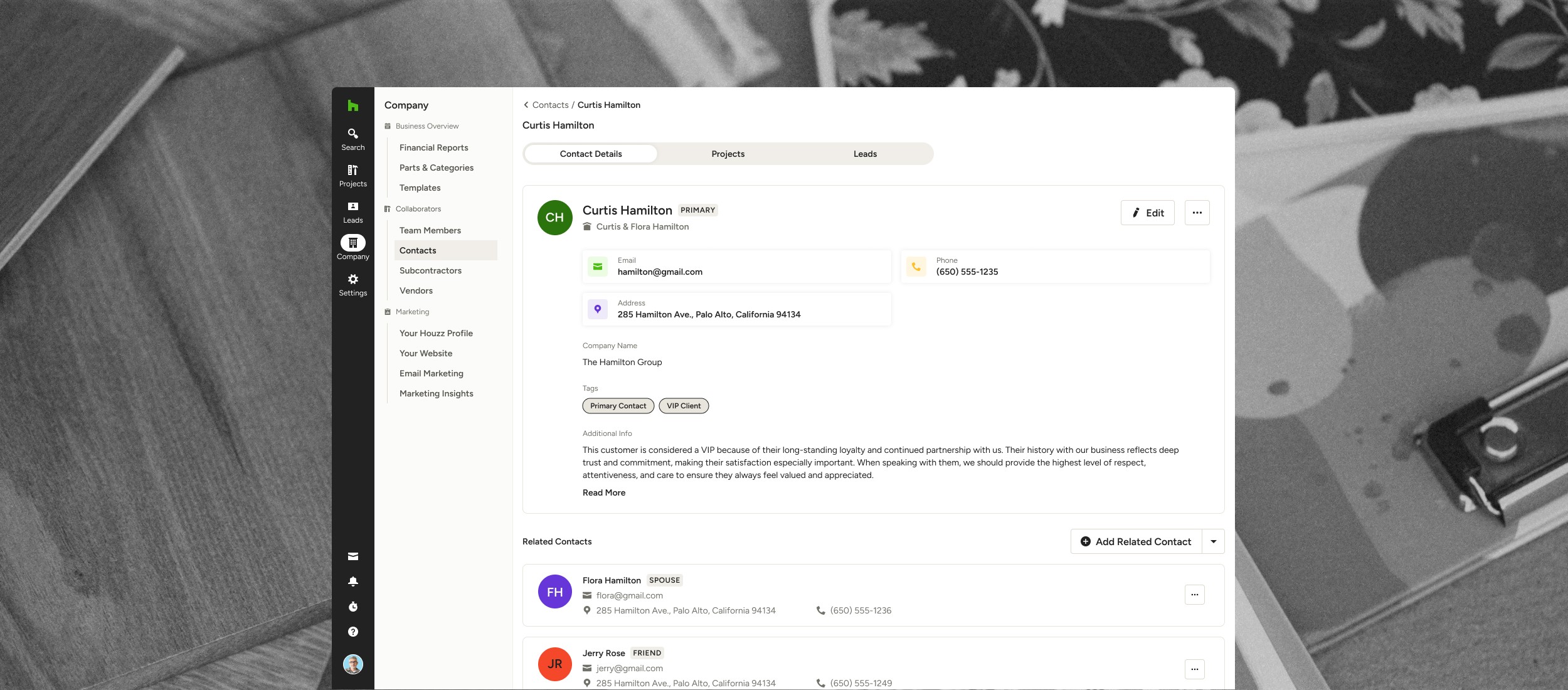
I reframed the client list from a flat collection of individuals into a flexible, relationship-based system that better reflects how pros structure their work. Research showed that users think in terms of companies and households made up of multiple contacts, not isolated people.
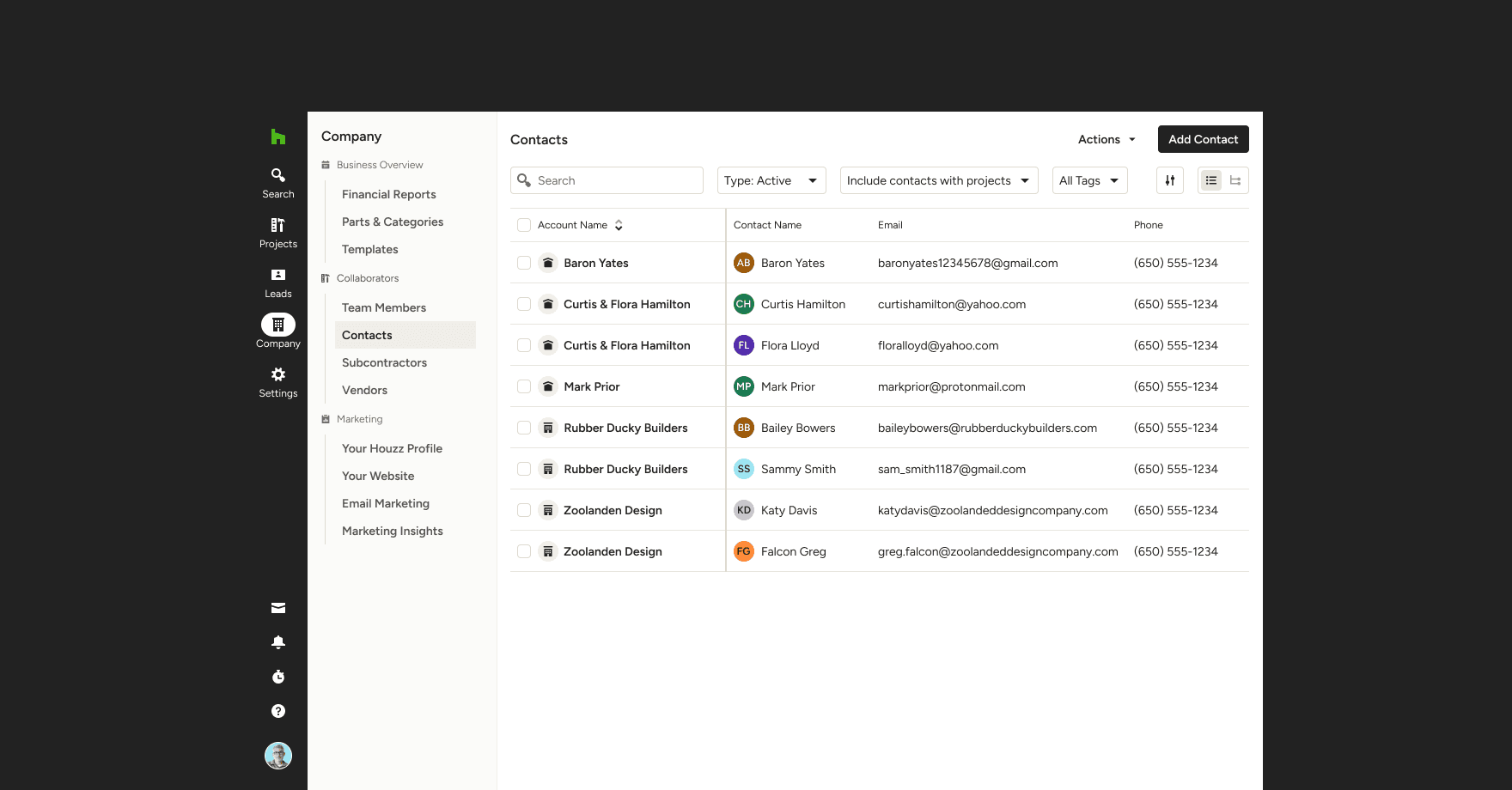
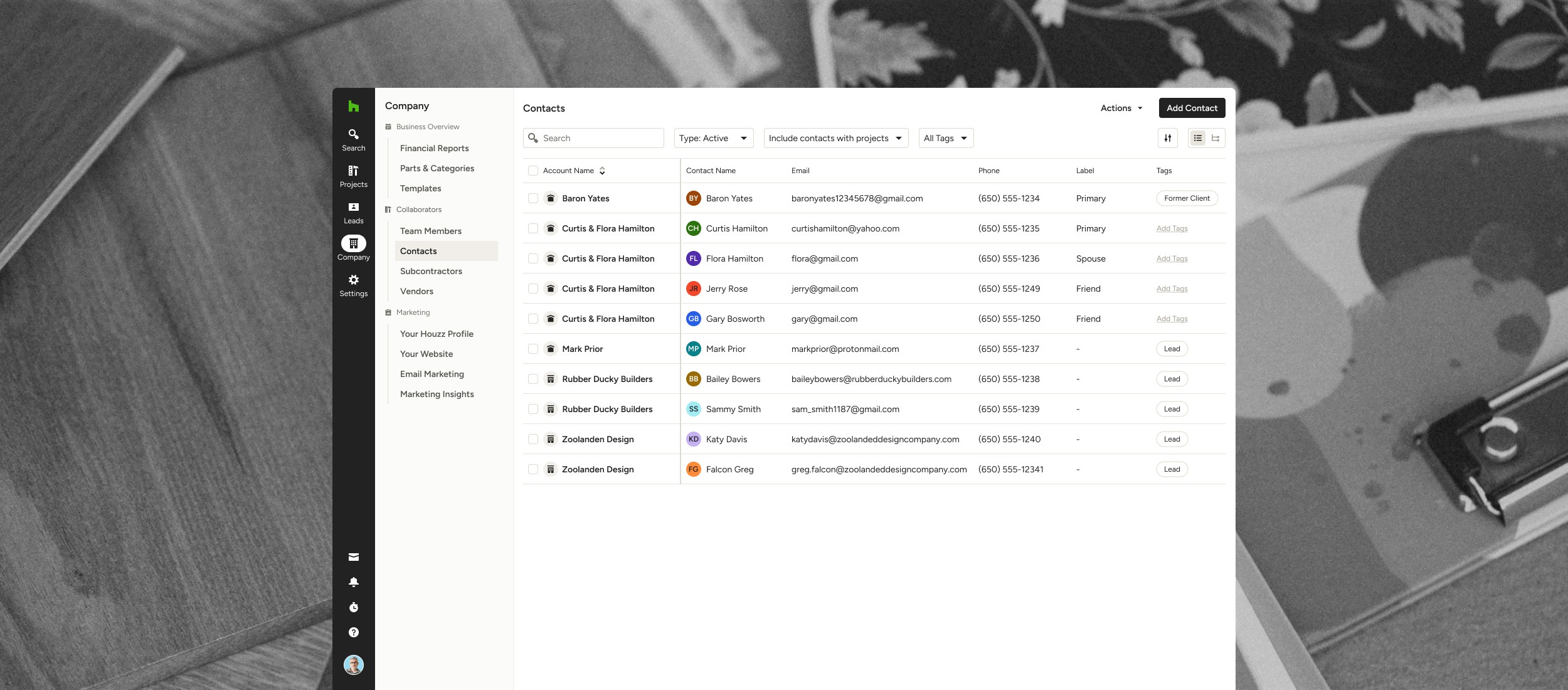
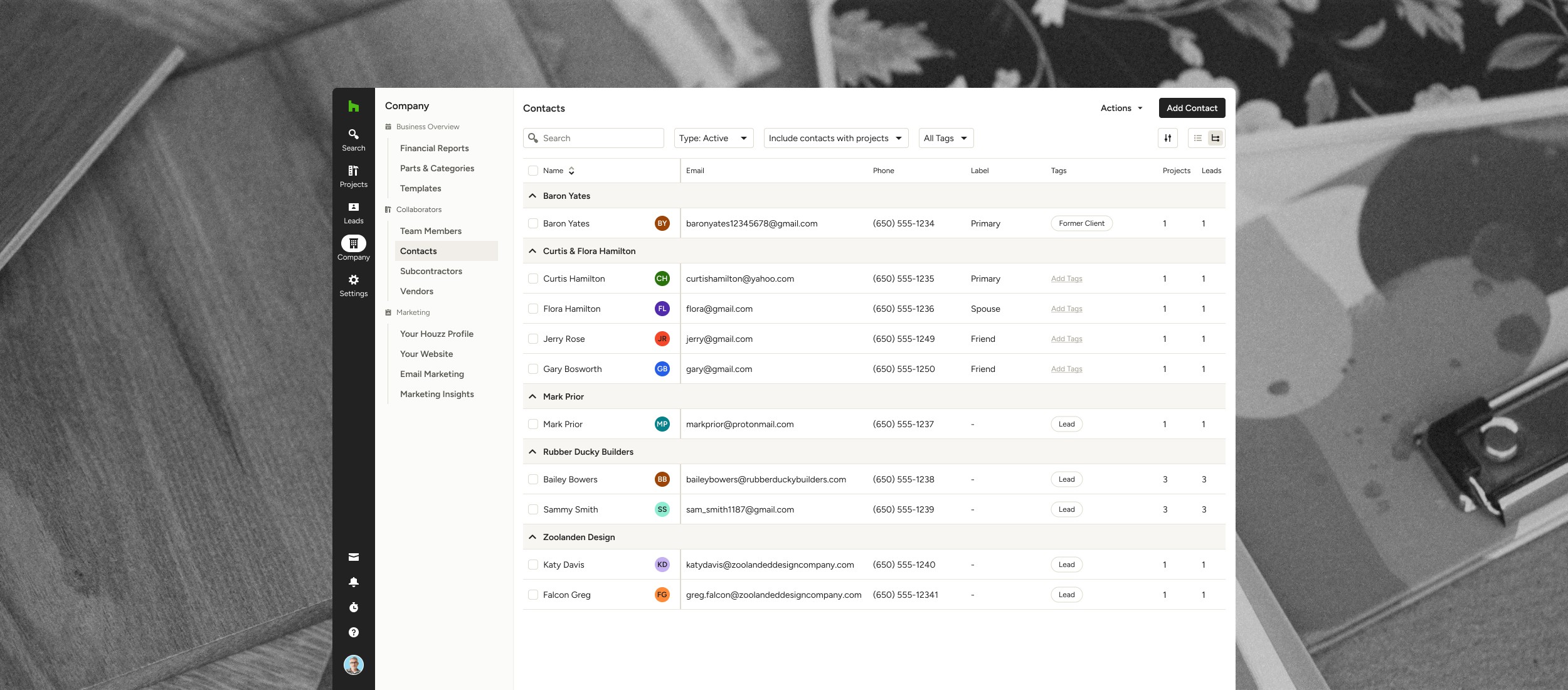
To support this, I introduced Account Name as a unifying layer to group related contacts under a single entity, reducing duplicate data entry and creating clearer relationships. I also added labels and tags to help pros define roles, categorize contacts, and filter based on their workflow.
I redesigned the client list into a customizable, multi-view table that allows users to switch between contact-level and account-level perspectives, improving visibility into contact relationships. I also clarified system language by reframing “Clients” as “Contacts” in this context, aligning the product with our user research findings.
Impact
This redesign establishes a foundational shift in how Houzz supports client management, moving from a rigid, individual-based model to a system that reflects real-world relationships. While the feature has just launched and quantitative results are not yet available, it unlocks critical capabilities required to support more complex, enterprise-level use cases.
Early feedback from internal teams and user research indicates stronger alignment with how pros actually manage their businesses, positioning Houzz to better serve enterprise-level customers over time.